Destination comparison

United Kingdom eSIM plans compared

Check each required place against the exact package before comparing dated catalog snapshots.

Approved providers3
Verified in catalog16
Latest verificationSep 22, 2026

United Kingdom decision guide

Which United Kingdom eSIM fits your trip?

Start with your actual places, not just a UK label. Keep Northern Ireland distinct from Ireland, and check Jersey, Guernsey or Isle of Man separately against the exact package. Geographical relationships do not prove commercial inclusion. Then compare the same product's data, validity, network disclosure and terms. The cards below are dated September 22 snapshots, not refreshed October 7 offers; our new place-name check was added October 7, 2026.

This pilot retains one September 22, 2026 catalog snapshot from GigSky, Nomad, and Maya Mobile. The shortlist comes from structured plan records and trip fit; commission is not a ranking input. Prices are source-checked catalog values from an official plan API, approved partner feed, or official provider page. They are not independent checkout totals, so tax, fees, currency conversion, promotions, and refund conditions still need to be confirmed at checkout.

The United Kingdom is not a single performance environment: city buildings, rural roads, rail corridors, coastlines, handset bands, congestion, and roaming policy can all change the result. The selected records name networks such as O2, EE, Hutchison 3G, and Three for some plans, while GigSky's September 22 UK extraction did not disclose a local network. This page keeps every network claim attached to the exact plan and does not turn a published name into a nationwide coverage or speed guarantee.

UK place-name check • sources read October 7, 2026

Separate the place on your ticket from the package label

Use the ONS administrative geography to distinguish the UK's four constituent countries: England, Scotland, Wales and Northern Ireland. Ireland is separately named in Common Travel Area guidance. The Ministry of Justice's Crown Dependencies page explains that Jersey, Guernsey and the Isle of Man are not part of the UK and are not Overseas Territories. These are geographical distinctions, not eSIM coverage certificates.

Place classification and package evidence are separate
Actual required placeGeographical labelCommercial question still to answer
England, Scotland or WalesConstituent UK countryDoes this exact package's UK entry cover the required stay?
Northern IrelandConstituent UK country; not the same label as IrelandResolve any ambiguous product wording for the actual stop.
IrelandSeparate country entryLook for Ireland in the same selected package, not just UK.
Jersey, Guernsey or Isle of ManCrown Dependencies, outside the UKAsk separately for each required place; a UK relationship does not supply an entitlement.

The Common Travel Area groups the UK, Ireland and the Crown Dependencies for its stated arrangements. Our editorial inference: membership of that arrangement cannot replace a provider's included-destinations list. This page does not give visa advice or assume every traveller has the same movement rights. A support answer about “overseas territories” also must not be silently expanded into a rule for Crown Dependencies.

The regional card on this UK page is not a UK-only product

The Nomad card below retains the September 22 Europe 5 GB - 30 days record, not a UK-only product. On October 7, the exact Europe page's acquired 35-place list named United Kingdom, Ireland and Gibraltar; both complete 35/36 variant lists were not acquired. Jersey, Guernsey and Isle of Man remain unconfirmed here, not proven excluded.

The separate UK 5GB / 30-day product warns that overseas territories may not be covered and recommends asking support before buying. That warning is not a complete dependency list. Neither page revalidates the old USD card prices or proves a final checkout total. We do not transfer a UK landing page's general network, phone-number or activation language onto the selected Europe package, or treat another provider's list as its scope.

Build a place-name card before comparing another offer

Start with the names that appear in your own booking, not the heading under which a booking site grouped the trip. Copy the required town or island and the dates of that stay into a private note. Give each place its own line, even when several stops sit under one holiday description. Keep the wording precise enough that a support agent can identify the intended service area without guessing what you mean by “the UK” or “Ireland.” This is a naming exercise, not a claim that a town has signal.

Keep two columns that you cannot accidentally merge: the place you need and the place the product source names. For a Northern Ireland stop, do not substitute an Ireland entry merely because both names contain Ireland. For a Jersey stop, do not substitute London merely because the booking describes a British itinerary. Preserve the actual stop while you resolve the product wording. The purpose is to make a missing commercial answer visible, not to declare the destination unavailable based on a name mismatch alone.

Add one product identity line above these place rows. Record the provider, full package name, allowance, duration, regional variant if one is shown, and the source read date. A product page you opened today is not necessarily the purchased package you already have. If the original purchase was a Europe package, label the note Europe rather than replacing it with the title of a UK page found later. A replacement offer deserves a separate product identity line, so its answers cannot quietly overwrite the original package's unknowns.

Use three evidence labels on your note: “named in this exact source,” “explicitly excluded by this exact source,” and “not resolved by this source.” Each label should have a short source reference next to it. A source that fails to name your required place belongs in the unresolved category until you have an applicable answer; silence is not the same as an explicit exclusion. Likewise, a place classification from a geographical source belongs in the naming column, not the commercial inclusion column.

Keep the current scope question narrower than a general request for the best UK eSIM. Once the required place and exact product are identified, ask only about the unresolved place. This lets you compare an answer with the note's specific gap. A broad reply about dependable UK service may sound reassuring but still leave an island or a Northern Ireland label unanswered. Save that as a partial answer rather than marking the whole itinerary cleared. You do not need a complicated scoring system to preserve an unanswered question.

Ask a question that cannot be answered with a different package

Here is an original editorial support prompt, not a quotation from a traveller: “For this exact package and variant, does the included service area cover my stay in [precise place] on [dates]? Please point me to the applicable destination entry or product-specific scope statement. If the label is UK, please explain how it applies to this named stop.” Send the product identity privately through the provider's legitimate support channel. Do not publish an order identifier, QR code or activation secret in a forum or screenshot.

Read the reply back against the original question. Does it identify the same product, address the actual place, and say where the scope is documented? If it answers about a different plan, keep that reply as information about an alternative, not proof about the package under review. If it says only that the provider sells plans for the destination, the purchase decision is still open. Ask whether the existing package includes the stop or whether an additional purchase would be required; do not infer that distinction yourself.

Separate an answer about included service area from an answer about performance. A product-specific inclusion statement can resolve the naming gap without promising continuous reception on a train, at a hotel, or during a transfer. Your note can therefore say that the scope question is answered while leaving location-level performance untested. Keeping those outcomes separate avoids both extremes: rejecting a plan because there is no personal speed test, or treating a useful scope reply as a guarantee of every connection.

If the response remains ambiguous, keep the unresolved label and decide what you need before relying on that stop. You might wait for a clearer product statement or compare a separately identified alternative whose scope answers the required place. This is an editorial decision process, not a recommendation to buy twice or a claim that a refund will be available. Check any alternative on its own terms. Never reuse an answer from one product merely because the same brand logo appears on another.

Reopen only the naming gap that a route change creates

Consider a hypothetical London–Belfast itinerary. The note keeps both actual stops visible and records the selected package's UK wording beside them. It does not turn the word Belfast into an Ireland entry. If the traveller later adds Dublin, add a new Ireland row rather than changing the Belfast row or assuming the original UK wording answers both. This example illustrates the check; it does not assert that a particular plan includes either city, or that we travelled the route.

Now consider a hypothetical London trip extended with a stay in Jersey. Retain the London row and add Jersey as its own required place. Do not write “UK coverage confirmed” across the new row simply because that was the decision for the original itinerary. The new question is about the same identified package and this additional stop. If a provider supplies a suitable alternative, create another identity line for it. That keeps the scope of each answer visible instead of hiding the extra purchase behind an unchanged holiday label.

A similar exercise works when a traveller replaces Guernsey with the Isle of Man. Archive the row for the removed stop and create a row for the new one; do not transfer its evidence label automatically. The note should explain which required place changed and which commercial question remains. Once that question is answered, broader data allowance, validity and network comparisons can continue in the appropriate guide. A geographical crosswalk is useful precisely because it identifies where that broader work must start, not because it finishes every product check.

Before keeping the note as your purchase record, perform a short reader audit. Can someone else tell which places you need, which exact product you assessed, which source supports each label, and what remains unresolved? Remove any unsupported shorthand such as “all British islands included” if the note contains no applicable product evidence for that phrase. Keep a source's qualified wording qualified. This audit is about the traceability of your decision, not a numerical confidence estimate or a prediction of how the connection will perform.

Carry forward only the narrow conclusion the evidence supports: this named stop's package-scope question is answered, explicitly excluded, or still open. Keep all other questions in their own fields. A downloaded profile, a brand recommendation or a familiar destination label cannot fill the missing scope cell. If your itinerary changes after purchase, return to the actual place names and the same product identity before you carry forward the earlier answer. That is the practical handoff this UK-specific check adds to a regional comparison.

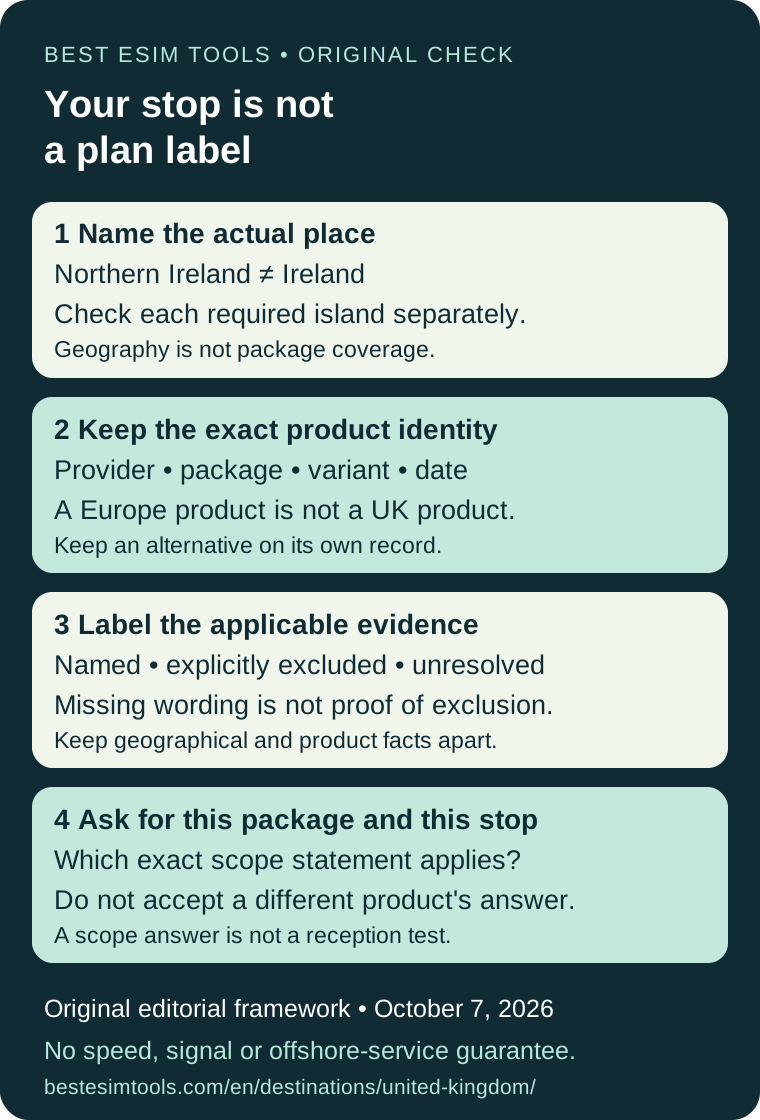
Original four-stage UK itinerary scope check: precise place, exact package, separate evidence label, and a product-specific support answer. None of these stages is a reception test.
Original editorial place-name check, October 7, 2026. Geographical classification helps frame the question; only applicable product evidence can answer package scope. This is not a coverage map or a field test.

For a broader regional route, use the Europe country-and-network evidence guide. General plan-scope choices belong in the global eSIM guide; phone menus belong in the installation guide. We have not personally measured rural signal, rail handoff or offshore service, and no such performance claim is made here.

United Kingdom eSIM

One dated catalog snapshot from each provider

The September 22 catalog recorded 16 plans; these three retained snapshots are not a new count or current checkout verification. Confirm the exact live package and checkout details with the provider.

Affiliate links may earn us a commission at no extra cost to you. Ranking is based on trip fit and verified plan data, not commission.

GigSkyUnited Kingdom 10 GB - 30 days
1
Price$8.32 Data10 GB Validity30 days HotspotNot verified VerifiedSep 22, 2026
NomadEurope 5 GB - 30 days
2
Price$17.50 Data5 GB Validity30 days HotspotAllowed VerifiedSep 22, 2026
Maya Mobile7 Days Unlimited Global Data
3
Price$19.99 DataUnlimited Validity7 days HotspotAllowed VerifiedSep 22, 2026

Local network context

Read the UK network disclosure before the price

The selected September 22 United Kingdom records collectively name O2, EE, Hutchison 3G, and Three. Nomad's September 22 Europe record includes EE, Hutchison 3G, and O2 for the UK entry, while Maya Mobile's selected global record names Three, EE, and O2. GigSky's September 22 United Kingdom catalog records do not disclose a local network in the source fields available to this comparison. That is an evidence gap, not proof that the plan cannot connect.

A named network is useful context but not a guarantee of signal at every address or route. The exact plan, roaming agreement, device bands, local congestion, network selection policy, and location all matter. Before a rural trip, long rail journey, or stay in Northern Ireland, open the exact provider source and confirm its current network and coverage terms. Do not copy Nomad or Maya Mobile's network claims onto GigSky, and do not treat one plan's list as a provider-wide guarantee.

Published 4G or 5G labels describe the source record's stated availability rather than a guaranteed speed. A comparable UK field study would need the same device class, cities and rural locations, time, attached network, signal conditions, rail handoff, download, upload, latency, and hotspot setup. Until that evidence exists, this page reports source facts and keeps performance rankings out of the comparison.

Evidence for the exact plans shown above
Provider and planNamed local networkHotspotActivationSource and dateField test
GigSkyUnited Kingdom 10 GB - 30 daysNot disclosed in September 22 sourceNot disclosed in September 22 recordStarts on first network connectionOfficial plan API Checked Sep 22, 2026Not personally tested
NomadEurope 5 GB - 30 daysEE; Hutchison 3G; O2 (4G/5G)Allowed in September 22 recordStarts on first network connectionActivate within 60 days of purchaseOfficial provider page Checked Sep 22, 2026Not personally tested
Maya Mobile7 Days Unlimited Global DataThree (4G)
EE (5G)
O2 (5G)
Allowed in September 22 recordProvider-defined triggerApproved partner feed Checked Sep 22, 2026Not personally tested

Catalog prices are shown on the plan cards. This ledger does not certify a checkout total, tax treatment, speed, or coverage at a specific address.

Choose by travel pattern

Three practical ways to narrow the list

These filters are comparison starting points, not paid placements or performance awards. Confirm the exact plan and final provider terms before purchase.

01

Short London or city trip

For about a week in London or another major city, begin with a modest fixed allowance if your main uses are maps, messages, tickets, translation, and occasional uploads. Compare validity and expected usage rather than choosing only by price; arrival and departure days still need coverage.

Compare 7-day options
02

Longer UK itinerary

For two to four weeks across England, Scotland, Wales, or Northern Ireland, compare a larger fixed allowance with an unlimited plan's stated daily high-speed and fair-use rules. Confirm the exact country coverage and activation trigger before installing, especially when the route includes rural or coastal areas.

Compare longer-stay options
03

Laptop or shared connection

If tethering is essential, begin with a row that explicitly says hotspot is allowed. Nomad and Maya Mobile disclosed allowed in the September 22 records; GigSky is not verified in the September 22 record. Allowed does not prove unlimited tethering, so check caps, fair-use language, device restrictions, and speed policy before relying on it for work.

Show confirmed hotspot options

Setup without wasting validity

Install carefully, activate by the plan rule

The selected records do not share one activation rule. GigSky and Nomad recorded first network connection on September 22, while Maya Mobile's September 22 record used a provider-defined trigger. Follow the instructions for the exact plan rather than transferring one supplier's setup process to another.

1

Check the phone

Confirm that the handset supports eSIM, is carrier-unlocked, and supports the bands needed for your route. Keep the primary SIM available if you need its number for verification, calls, or travel alerts.

2

Save the installation details

Use stable Wi-Fi to save the QR code, app instructions, or manual activation values. Keep the order email and support link available, and do not delete an installed eSIM unless the provider confirms it can be reissued.

3

Name and control the line

Label the line United Kingdom, keep data switching under control, and do not turn it on early when the plan says validity begins on first network connection. Record any installation window or purchase expiry before departure.

4

Connect and verify

At arrival, follow the provider's roaming and APN instructions, select the travel line for data, and test maps and messaging before leaving reliable Wi-Fi. If attachment fails, check the exact network and support instructions rather than repeatedly deleting the eSIM.

Hotspot, speed, and final price

Unknown stays unknown

The evidence table marks hotspot as allowed only when the exact plan record says so. An unknown value is not a negative review and is not permission to tether; it means the September 22 evidence was incomplete. The same boundary applies to throttling and rail handoff. A network list does not prove unlimited speed, seamless rural coverage, or unlimited hotspot data, and we do not infer missing restrictions from another provider's terms.

The price shown on a card is a September 22 source-checked catalog value in the displayed currency, not a price revalidated on October 7. Because this batch has no independent checkout capture, the final amount may depend on tax, fees, currency conversion, a promotion, or checkout settings. Confirm the final currency, refund conditions, validity trigger, and fair-use rule at the provider. If the linked source no longer matches the card, treat it as a discrepancy and do not rely on the cached value until the batch is reviewed.

No United Kingdom speed ranking appears here because there is no comparable firsthand test set. A useful future test should record the device and eSIM, city or route, time, attached network, signal conditions, radio generation, download, upload, latency, hotspot behavior, rail handoff, and visible throttling. Until that evidence exists, network names and published allowances remain source facts rather than editorial performance scores.

United Kingdom eSIM questions

Check these before you buy

Will a UK eSIM work in rural areas and on trains?

No plan should be treated as a blanket coverage or rail-performance guarantee. Check the exact plan's named network, provider coverage terms, device compatibility, and route. A source that does not disclose a network remains unverified on that field.

Can I use hotspot or tethering?

Read the current tethering permission and any caps in the exact purchased package's terms. The September 22 ledger above is a historical comparison, not permission to share today's connection. Do not infer a current restriction or entitlement from another supplier or package.

When does a United Kingdom plan start?

Follow the start condition and purchase or installation deadline stated for the exact order. A September 22 ledger entry is not a current instruction for a different UK or regional product. Keep the start date and end date in the same order record rather than borrowing another plan's rule.

Do these plans include a UK phone number or SMS?

This comparison focuses on travel data records. It does not promise a UK phone number, voice minutes, or SMS unless those fields are explicitly published. Keep another line available when calls or verification texts are important.

Is the displayed price the final checkout total?

No. The displayed USD amounts are September 22 catalog snapshots, not October 7 prices or independently verified checkout totals. Confirm the exact live package, final currency, taxes, fees, discounts and refund terms with the provider.

Does an Ireland entry answer my Northern Ireland scope question?

No. Northern Ireland is a constituent UK country, while Ireland is a separate destination label. Check how the same exact package identifies the actual required place; resolve ambiguous wording with product-specific support rather than borrowing another product's answer.

Does a UK label automatically include Jersey, Guernsey or Isle of Man?

No automatic inclusion is asserted here. These Crown Dependencies are not part of the UK. Check each required place against the exact selected package; an unresolved entry is not proof of exclusion, and a geographical relationship is not commercial coverage evidence.