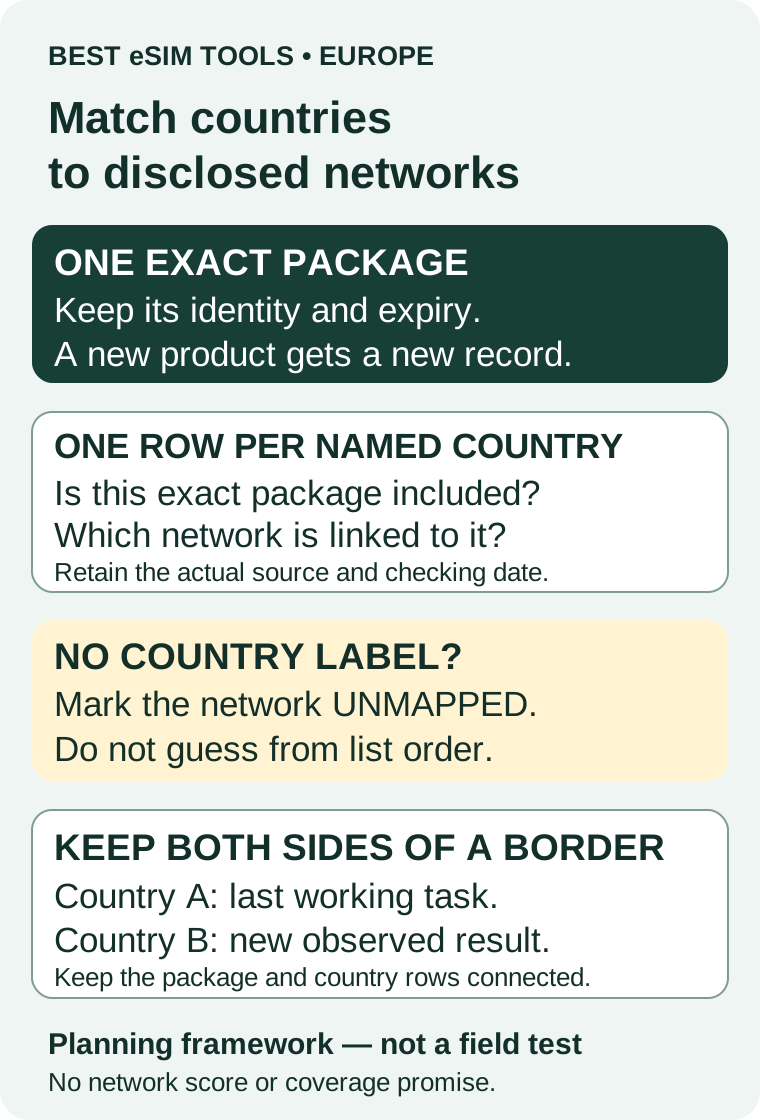
The useful object for a multi-country journey is a relationship: this product, in this country, with this disclosed network. A carrier collection answers a different question. It tells you that names appeared somewhere in an extraction, not which one belongs to your next stop. Our older table illustrates that limitation. Even a familiar name or an apparently obvious ordering is not permission to fill a missing country label. Keep that cell unresolved until a current product source or a precise provider reply establishes the relationship.
Give the whole worksheet one product identity
Write the exact regional package and its duration at the top, with the source date and a privately retained purchase reference. Do not put order identifiers or activation codes into a public worksheet. Below that header, create a row for each named country you actually require. Keep the package identity visible when adding rows; otherwise it is easy to combine one product's country list with another product's network disclosure. Two bundles sold by the same brand should not silently become one composite plan.
Keep the written expiry beside that shared header rather than inventing a fresh subscription record for every stop. If you replace the package or add a different product, start a new product version. A country change and a product change are different events. This simple distinction lets you see whether a later question concerns the original purchase, an additional arrangement, or a revised itinerary. The worksheet records the change without asserting what any particular provider's top-up terms allow.
Keep two evidence questions separate in every country row
The first question is whether the exact package includes that named country. The second is whether the source explicitly associates a local network with the package in that country. One answer does not supply the other. A country may be listed while its partners remain undisclosed; write included, network not disclosed, rather than failing the whole row or borrowing a network from a neighbouring entry. Conversely, seeing a carrier brand does not establish that the required country is included in your package.
For each answer, keep the source location and checking date. That might be the exact package page, a country-labelled network panel, or a private support reply about the same product. A general marketing page can identify a question to resolve, but it cannot always settle a purchased bundle's cell. When a source changes, retain the previous note as a dated note and add the replacement. You are maintaining an auditable route record, not overwriting history until everything looks complete.
Ask the missing-pair question
When a country is included but its network remains unmapped, ask support a narrow question: For this exact regional product, which networks are permitted in this named country, and which connection instructions apply there? Replace the placeholders with your actual package and destination. This is more useful than asking whether a Europe eSIM works in Europe. It identifies the missing relationship while giving the provider a chance to say that partner names are not disclosed. A non-answer should remain a non-answer in the worksheet.
If support answers with a different bundle, do not copy its networks into the original row. Ask whether the answer applies to the purchased product or record it as a separate alternative. If the reply names a network but not the country, keep the missing-pair question open. Retain private identifiers only in the provider's private support channel. The public planning example needs no QR code, subscriber identifier or order number to explain the method.
Worked planning example: three stops and an unmapped list
Imagine a France, Belgium and Netherlands itinerary. This is a hypothetical planning exercise, not a trip we tested and not an assertion about any provider's coverage. Suppose the package's current country list explicitly includes all three stops, but its extracted carrier names have no country labels. The inclusion cells can be completed from that exact source. The network cells cannot. Copying the full carrier list into each country row would hide the same gap three times rather than resolve it.
Leave each network cell marked unmapped, save the source, and ask for the pair needed at the most important stop. If a current answer resolves only Belgium, update only Belgium. The other rows stay unresolved. That does not prove bad reception in France or the Netherlands, and the resolved row does not certify performance in Belgium. The worksheet distinguishes what is disclosed from what you still need to ask, without turning absence of detail into a brand ranking.