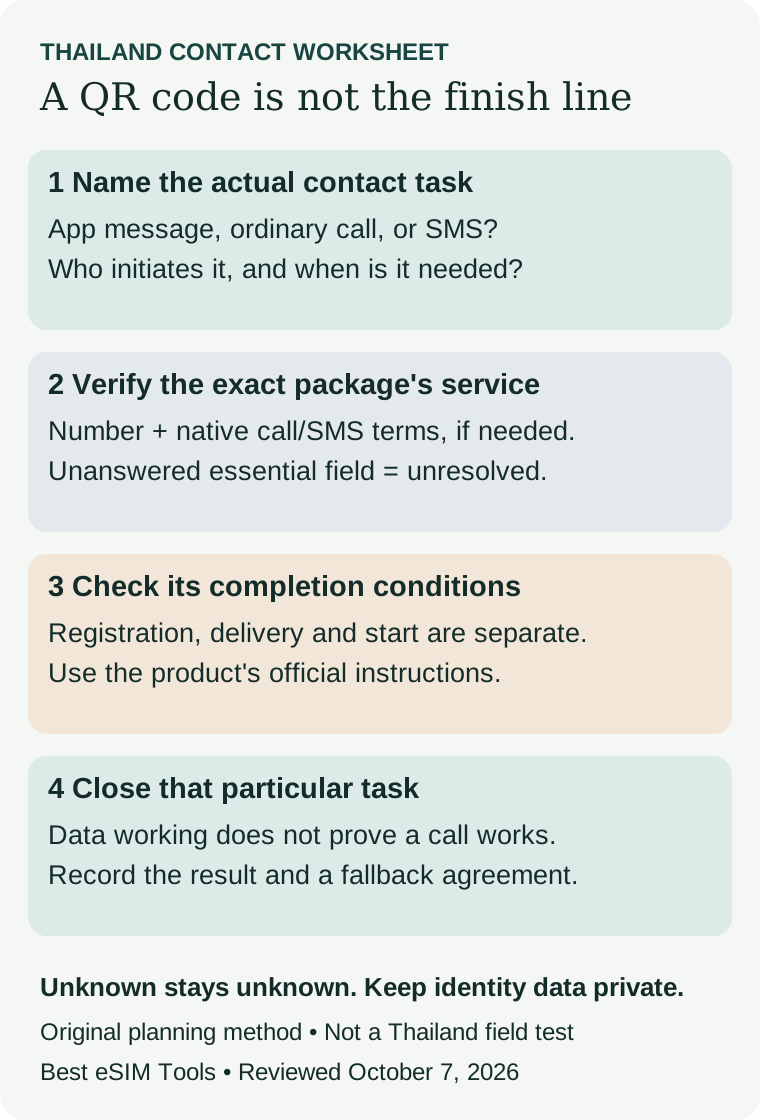
Thailand contact-task worksheet
Buy the service your local contact actually needs
Before choosing a Thailand package, write the first contact task that would be inconvenient to leave unresolved. Perhaps an accommodation needs a number it can call back, a driver wants an ordinary telephone call, or a booking is already handled inside a messaging app. These are different requirements. A package can be suitable for maps and uploads while the ordinary-call requirement remains open. Making that difference explicit is more useful than assigning every traveler the same provider.
Use a task sentence rather than a feature wish list: “I need the accommodation to call this number during my Thailand stay,” or “I only need to exchange messages in the agreed app.” Add who initiates the contact, what channel they will use, and when you need it. Do not assume that the other person uses your preferred app. If the arrangement is unclear, confirm the channel with the accommodation or contact before treating a data package as a complete solution.
The next line is the exact product, not merely the seller. Record the plan name, allowance, duration, country scope and purchase channel together. If the storefront offers both a travel-data package and a local-service package, keep two separate records. Do not transfer a number entitlement from one to the other because the logo or destination is the same. A network name tells you something about access; it does not, on its own, settle what telephone services your purchased account includes.
Write an acceptance condition for each needed service
For ordinary calls, record whether the required direction is outgoing, incoming, or both. For SMS, distinguish sending a message from receiving one. For a local number, record whether a number is assigned to this exact package, how the provider says to find it, and whether its service lifetime covers your required contact window. Do not fill an unanswered field from a generic eSIM description. Mark it unresolved and ask the provider a product-specific question before buying if the task is essential.
A phone number, an SMS entitlement and a particular third-party verification code are not interchangeable acceptance conditions. Even when a plan documents ordinary messages, this worksheet does not certify delivery of a bank or app's code. Keep that requirement separate and obtain guidance from the service that sends it. This page does not perform any account verification or claim that a local number will solve every sign-in problem.
A useful support question includes the product and the task without private identifiers: “For this exact package, can an accommodation call the assigned Thai number during the included period, and what must I complete before incoming calls work?” Ask separately about outgoing calls or messages if those matter. The answer should identify the entitlement and any required registration or activation step. A response about internet access alone leaves the ordinary-call task unanswered.
Keep purchase, registration and usable service separate
Make a small completion record with one row per stage and three columns: what the provider requires, what you have actually completed, and what remains unresolved. An order confirmation belongs in the purchase row. A delivered QR code belongs in the delivery row. If identity registration applies to the product, record only its completion status and the provider's official route, not a copy of identity material in a shareable travel checklist. Keep any sensitive documents or account identifiers out of public comments and screenshots.
This record is not an instruction to submit identity material to any particular screen. Use the provider's published process and verify the destination before supplying documents. If the initial process cannot be read, ask the provider about the exact purchase channel and wait for a usable official instruction. Do not turn a product being available online into proof that registration is already complete. Likewise, a statement about a carrier's own tourist product does not establish the process for a different seller's roaming package.
Put the relevant clock next to each action. “Register by,” “activate within,” “package begins when,” and “number remains usable until” describe different obligations. If the source does not state one of them, leave that cell unknown. When the flight changes, recheck the affected clocks rather than assuming that downloading a profile reserved all the days you need. If a purchase window and a service duration overlap, the provider must explain which event controls this exact order.
Keep a dated source note for each confirmed cell. If you switch from a fixed-data package to an unlimited or local-service option, create a new product record instead of editing only the price. Reopen the installation trigger, native services and registration fields too. That prevents an attractive replacement offer from silently inheriting conditions that belonged to the original shortlist. It also makes a support conversation easier to resolve because the intended product is not ambiguous.
Three hypothetical Thailand contact cases
An app-only Bangkok arrival. Imagine that the accommodation has already agreed to use an app and the first tasks are messages, maps and a booking page. The local-number requirement is absent in this example, not “confirmed” for the chosen data package. The buyer still checks the installation/start instruction and any applicable registration requirement. The useful result is a documented way to finish those actual tasks, not an extra telephone feature bought without a need.
A Phuket accommodation that calls back. Imagine the contact says it will make an ordinary call to the traveler's Thai number. A successful mobile webpage would not close this task. The buyer needs explicit number and incoming-call terms for the exact package, the required registration state, and a documented way to identify the number. If those are not obtained, agree another working contact arrangement before relying on the purchase. This is a service-planning example, not an assurance about reception at a Phuket property.
A Singapore-first trip that later reaches Thailand. Imagine the buyer needs data in both countries but only needs a local call during the Thai stay. Keep the route-data requirement and the Thailand contact requirement as two lines. An international data package may address the first while leaving the second unresolved. Compare a documented combined arrangement with a separately confirmed contact method; do not assume a Thailand product also covers Singapore or that a regional data package includes Thai native calls. The country coverage decision remains with the international-travel scope guide.
Close the task, not just the order
When service should be usable, check the particular task you wrote down. An ordinary-call requirement needs the relevant permitted call, not merely an internet page. An app-only requirement needs a fresh exchange in that app. Record the time and outcome privately; describe a failure by the stage that remained incomplete. Do not infer every service from signal bars or one successful task. This is a personal trip check, not a published coverage, speed or reliability score.
If the contact task is still open, retain the profile and use the provider's support process. State the exact product, the documented requirement and the action that failed; provide private order or device details only through that support channel. Generic phone menus belong in our installation guide, device and home-line settings in our iPhone travel guide, and connection diagnosis in our activation troubleshooting guide. This worksheet resolves the Thailand purchasing task; it is not a replacement for those instructions.
The finished record can be short: contact task, exact product, required native services, official registration route, start event, remaining gap and fallback agreement. A blank gap is acceptable only when you consciously do not need that feature. An unanswered essential feature is a reason to pause that choice, not a reason to invent a capability. Recheck the record after a package change or date change, and compare price only among arrangements that meet the task.